
Sterile Processing Tray Completeness: Can a Camera Do the Second Check?
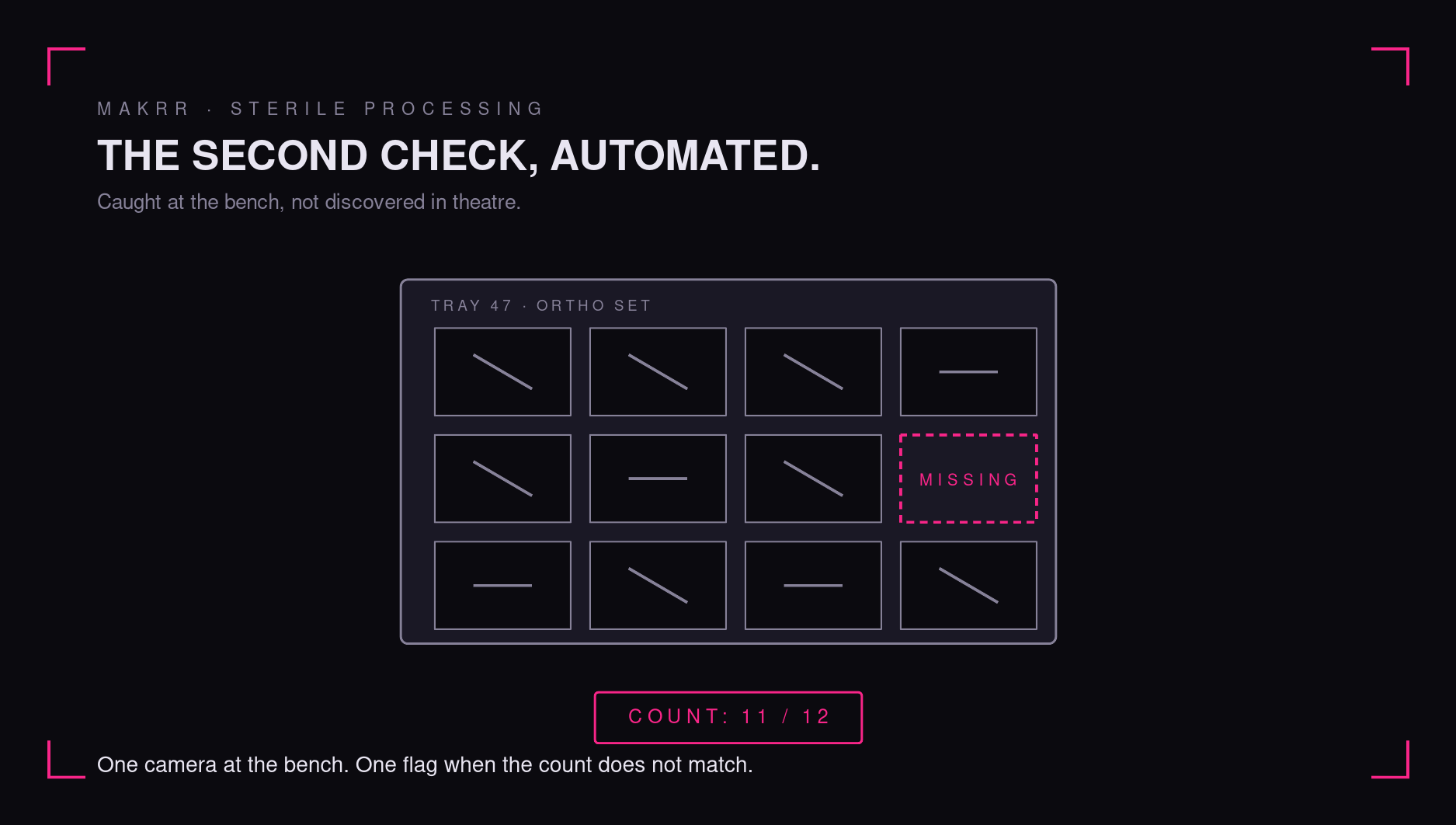
Every sterile processing department runs the same check, many times a day. A technician assembles a tray, works down a count sheet, and confirms that what is on the bench matches what the sheet says should be there. Then the tray is wrapped, sterilised, and sent to theatre, where somebody finds out whether the check was right. This article looks at what the published data says about where that check fails, why instrument tracking systems do not close the gap, and what a camera running at the assembly bench can and cannot add. It is written for sterile services and decontamination managers rather than for a technical audience.
The check that fails is a looking task
The most useful finding in the sterile processing literature is not about how often errors happen. It is about what kind of task is failing when they do. An observational study of surgical instrument errors found that 88.6 percent of observed errors related to failures in visualisation, meaning the work of identifying an instrument, determining whether it is functional, detecting bioburden, and assembling the correct set into the correct tray. Not failures of process, not failures of documentation. Failures of a person looking at something and not seeing what was there, or seeing something that was not. The same body of research is consistent about which two errors dominate. Failure to identify bioburden and missing instruments, meaning items listed on the count sheet but absent from the tray, together account for roughly 83 percent of reported surgical instrument errors. In one observational set, missing instruments were the single most common error type. The rates vary by how you count. One study of 33,839 instrument packages recorded 398 errors, an overall rate of 1.18 percent. A 30-day prospective study of 17,348 trays found 86 errors, of which 38 were assembly errors. A third, counting from the theatre end rather than the department end, found that 26 percent of observed surgical cases experienced at least one instrument error. Those numbers are not directly comparable, and they should not be averaged. What they agree on is the shape of the problem. Tray assembly is a high-volume visual task performed by people under time pressure, and it fails at a low but persistent rate, in a way that is only discovered downstream.
What it costs when it is discovered downstream
A missing instrument is found in theatre, which is the most expensive place in the hospital to find anything. Published estimates put operating theatre time between roughly 50 and 150 US dollars per minute, with some sources quoting higher, depending on facility, case complexity, and what is included in the calculation. A typical delay from a missing or malfunctioning tray is short, around seven minutes. A single missing instrument that requires the team to find a substitute or fall back to immediate-use sterilisation can run 15 to 30 minutes. One instrument supplier puts the delay cost of a single missing or malfunctioning instrument at up to 259 US dollars, before the cost of the waiting surgical team.
Two caveats an operations lead should apply to those figures. Most of this data is from US healthcare systems, and theatre minute costs in European public and private settings differ substantially. And the delay cost is only the part that is easy to count. The harder costs are list disruption, the knock-on to later cases, and the effect on a department that is already short of technicians.
The point is not the specific number. It is that the economics are lopsided. The check costs a minute at the bench. The failure costs a great deal more, and it is paid by a different department.
Why instrument tracking does not close this gap
Most sterile services departments of any size already run an instrument tracking system, usually barcode or RFID based, often integrated with theatre management software. These systems are genuinely valuable and are frequently a requirement, since traceability is both a regulatory obligation and a patient safety one. Decontamination units across the UK and Ireland are commonly expected to hold EN ISO 13485 accreditation, which requires regular audit of processing and management of invasive devices.
But it is worth being precise about what those systems actually record.
A tracking system tells you that tray 47 was processed, by which technician, at what time, through which washer and which steriliser cycle. That is a complete audit trail of the tray as an object moving through a process. It does not tell you what was inside it.
The link between the tray identifier and its actual contents is the count sheet, and the count sheet is confirmed by a person looking. The tracking system inherits whatever that person concluded. If the technician marked the sheet complete and one item was not there, the tracking system records a correctly processed tray with a full set, and does so with a timestamp and a name attached. The audit trail is intact. It is just wrong.
This is not a criticism of tracking systems. They were built to solve traceability, and they solve it. The gap is structural: the one step in the chain that is not captured electronically is the visual confirmation, which is also the step the data says fails most often.
What a camera at the bench actually does
A camera positioned over the assembly bench watches the tray as it is laid up and produces a count and a classification of what it can see, against the expected set for that tray type. The mechanics are ordinary. The detection task is recognising specific object types and counting them in a frame. That is the same underlying task whether the objects are components on a production line or instruments on a bench, and it is a task computer vision does well when the objects are laid out visibly and the model has been trained on the actual items in question. Three things determine whether it is useful in a real department:
It has to run on the cameras you can actually install. Standard CCTV, RTSP, and USB cameras are enough. A department that needs a specialist imaging rig for each bench will never get past the capital request.
It has to be trained by the people who know the trays. The person who can label a photograph of an orthopaedic set correctly is a sterile services technician, not a data scientist. If the system requires an external integrator every time a tray composition changes, and tray compositions change constantly, it will be abandoned within a year. This is the reason MAKRR is built as a no-code platform: the domain expert labels the examples, presses one button, and has a working detector.
It has to run on site. More on that below, because in a hospital it is the question that decides everything. The output is not a replacement for the technician. It is a second opinion, generated automatically, at the moment the tray is laid up rather than when it is opened in theatre. Where the count agrees, nothing happens. Where it disagrees, the technician looks again. That is the whole intervention.
The privacy question, answered before it is asked
In a hospital, any proposal involving a camera meets the same question, and it should.
The answer that works is architectural rather than contractual. MAKRR trains models in the cloud and deploys them to an edge device inside the facility, so inference runs on hardware the hospital owns. The video is analysed locally. What leaves the device is the result, meaning a count, a flag, an exception record, rather than a stream of footage going to an external service.
Two things follow from that. The data footprint is small, which aligns with the data minimisation principle GDPR is built around. And the governance story is short enough to explain in a meeting, which in practice matters as much as the technical position.
It is also worth being direct about what is being detected. The subject is the instrument, not the person. A tray completeness check does not need to identify who assembled it, and should not be designed to. The tracking system already knows who was on shift. Adding facial identification to a bench camera creates a staff monitoring problem in exchange for information the department already holds.
This is general information about data architecture, not legal advice. Confirm your own position with your data protection officer.
A realistic first project
The teams that get value from this start with one tray type rather than the whole department. Pick a set that is used often, has a stable composition, and has a history of coming back short. Photograph or record the assembly of that set enough times to cover normal variation. Label the instruments. Train a detector. Run it in parallel with the existing check for a few weeks without acting on it, and compare what it flags against what the technicians found.
The comparison is the business case, and it belongs to you rather than to a vendor. A model of this kind can be ready in under a day of actual work. The parallel run is what takes weeks, and it should. If your department has already put a tracking system in and still gets trays returned short, the gap described above is probably the reason, and the check is worth testing.
To see how this maps onto your own tray types and bench layout, book a 30-minute demo, or start a free trial and label a set this week. There is more on the wider set of non-clinical hospital use cases in our article on computer vision in hospitals, on the architecture in edge versus cloud computer vision.